

RESIN BOUND VS BLOCK PAVING DRIVEWAYS
Resin bound and block paving are the two driveway finishes people compare most. Both last well when they are built on a proper base, but they look different, drain differently and are repaired differently.
Here is how to decide between them.
Get My Free Quote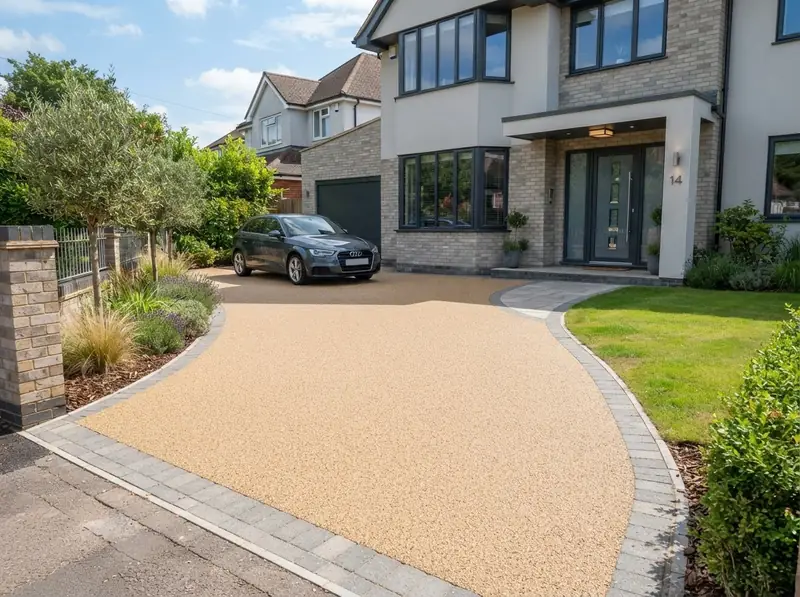
THE SHORT ANSWER
Choose resin bound if you want a smooth, seamless finish with no joints, no loose stones and rain that drains straight through.
Choose block paving if you want a classic look, lots of patterns and colours, and a surface where a damaged area can be lifted and relaid without anyone noticing.
HOW EACH ONE IS BUILT
Block paving is concrete blocks laid on a bed of sand over a compacted stone sub-base. The edges are held by restraints set in concrete, the blocks are compacted, and kiln dried sand is brushed into the joints so the blocks lock together.
A resin bound driveway is natural aggregate mixed with resin on site and trowelled smooth to an even depth, usually around 18mm for a driveway. It needs a sound base underneath. That can be a new base we build, or an existing tarmac or concrete drive in good condition.
Resin bound is not the same as resin bonded. Resin bonded has stones scattered over a resin coat, which leaves a loose, gravelly surface that does not drain. We lay resin bound.
DRAINAGE AND THE PLANNING RULES
In England, paving more than five square metres of a front garden needs planning permission unless the rain soaks away on your own property, either through a permeable surface or into a border, lawn or soakaway.
- Resin bound is permeable, so it usually meets that rule on its own, as long as the base underneath lets water through.
- Standard block paving does not let water through, so it needs falls to a border, a channel drain to a soakaway, or permeable blocks.
- Either way, we plan the drainage on the site visit so the drive meets the rule.
There is more detail in our guide to planning permission for a new driveway.
LOOKS AND CHOICE
Block paving gives you the most choice of pattern and colour: herringbone for strength, borders and banding, and tumbled blocks that suit older houses.
Resin gives a seamless, modern finish in a wide range of stone blends, from silver greys to warm golds, and it can run neatly up to steps and around curves. Recessed manhole covers can be filled with the same resin so they almost disappear.
LOOKING AFTER THEM
- Block paving: sweep regularly, top up the jointing sand when it washes out, and deal with weeds in the joints early.
- Resin bound: sweep regularly and wash it down now and then. There are no joints for weeds to root in, although moss and leaves should not be left on it.
- Both: clean oil spills quickly.
REPAIRS
This is where block paving has the edge. If a section is dug up for a pipe or a cable, the same blocks can be lifted and relaid and the repair barely shows.
A patch in resin is harder to hide, because new resin rarely matches weathered resin exactly. That is one reason we check the base so carefully before laying resin: most resin problems start with a base that was not sound.
WHICH SUITS WHICH HOUSE?
- Short, sloping drive where water runs towards the house: resin, because rain soaks through instead of running down.
- Busy family drive where cars turn on the spot: block paving in herringbone, which locks in every direction.
- Older house that needs a traditional look: tumbled block paving or a natural resin blend.
- Solid existing tarmac or concrete drive: resin can often go straight over it, which keeps the job shorter.
We bring samples of both to the free site visit and tell you honestly which suits your drive.
RELATED PAGES
READY TO TRANSFORM THE OUTSIDE OF YOUR HOME?
Free site visit, fixed written quote, no pressure.
Tell us what you have in mind and we will get back to you to arrange a time to come and look.