

PORCELAIN VS INDIAN SANDSTONE PATIOS
Porcelain and Indian sandstone are the two patio materials we are asked about most. Both make a great patio when they are laid properly, but they behave differently once they are down, and the right one depends on your garden and how much looking after you want to do.
Here is how they compare, in plain terms.
Get My Free Quote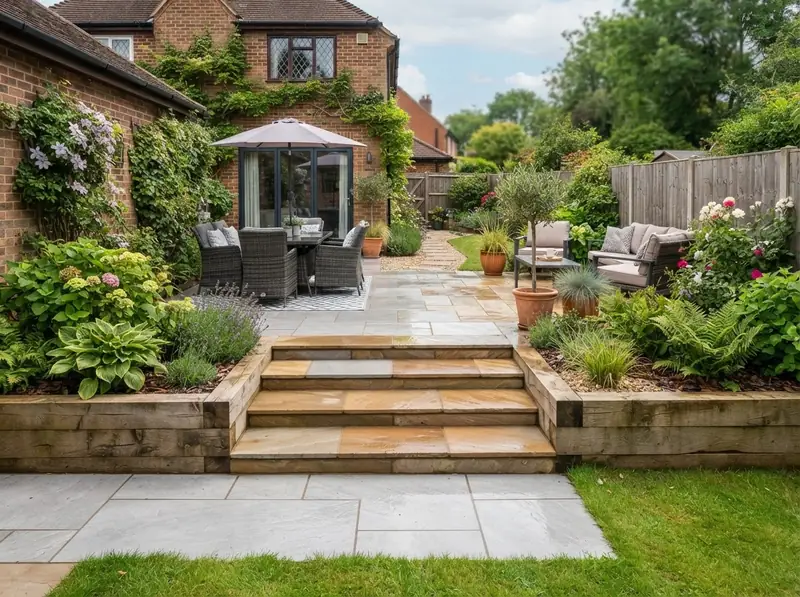
THE SHORT ANSWER
Choose porcelain if you want a patio that stays clean with very little effort, a crisp modern look, and colours that stay as they are.
Choose Indian sandstone if you want natural colour variation, a softer and more traditional look, and you do not mind a clean now and then. It suits older houses and cottage-style gardens well.
PORCELAIN: WHAT YOU NEED TO KNOW
Outdoor porcelain is usually 20mm thick and made to be very dense, so it soaks up almost no water. That is why it shrugs off stains, does not need sealing and is slow to go green, even in shade.
- Very low maintenance: a sweep and a wash with a hose or a soft brush is usually enough.
- Colour and size are consistent from slab to slab, which gives a clean, modern finish.
- Outdoor ranges have a textured, anti-slip surface. Check this when you choose, because indoor tiles are not the same thing.
- It is harder to lay well. Porcelain needs a priming slurry on the back of every slab so it bonds to the mortar, and cutting it needs a diamond blade.
The trade-off is looks. Some people find porcelain too uniform next to older brick, although wood-effect and stone-effect ranges have come a long way.
INDIAN SANDSTONE: WHAT YOU NEED TO KNOW
Indian sandstone is a natural stone, so every slab is slightly different. Popular colours include greys, browns and buff blends, and it usually comes with a riven (naturally split) face or a smoother sawn finish.
- Natural variation in colour and texture, which looks warm and settles into a garden well.
- Riven stone gives good grip underfoot.
- It is porous, so it can mark and will go green faster in shade. A periodic clean keeps it looking right, and a sealer can help.
- Calibrated stone is cut to one thickness, which makes for a flatter, more even patio than hand-cut slabs of varying depth.
Sandstone weathers over time. Many people like the way it mellows, but if you want the patio to look exactly as it did on day one, porcelain is the better fit.
HOW THEY COMPARE
| Porcelain | Indian sandstone | |
|---|---|---|
| Upkeep | Very low, no sealing needed | Occasional clean, sealing optional |
| Look | Uniform, modern | Natural variation, traditional |
| Stains and algae | Resists both well | Can mark, greens in shade |
| Grip | Textured outdoor finish | Riven face grips well |
| Laying | Needs priming slurry and diamond cuts | Laid on a full mortar bed |
| Best for | Shaded gardens, busy family patios | Period homes, cottage gardens |
WHICH ONE FOR YOUR GARDEN?
- North-facing or shaded patio: porcelain, because it is slow to go green.
- Victorian or Edwardian house: sandstone usually sits better against older brick.
- Modern house with wide glass doors: large-format porcelain gives a clean line from inside to out.
- Children and dogs: porcelain is easier to keep clean after muddy feet and paws.
- Tight budget for the slabs themselves: compare like for like, because ranges vary a lot in both materials.
On most jobs, the groundwork and the laying matter more to how long the patio lasts than which slab you pick.
HOW WE LAY BOTH
Whichever you choose, the method is the same where it counts. We dig out to the right depth, build and compact a sub-base, and lay every slab on a full bed of mortar, not on dabs or sand, so nothing rocks or sinks. The patio sits below the damp proof course of the house and falls gently away from it so rain runs into the garden, not against the walls.
For porcelain we add a priming slurry to the back of each slab. For both, the joints are pointed neatly so weeds have nowhere to start. We bring samples of both materials to the free site visit, so you can see them outside in daylight before you decide.
RELATED PAGES
READY TO TRANSFORM THE OUTSIDE OF YOUR HOME?
Free site visit, fixed written quote, no pressure.
Tell us what you have in mind and we will get back to you to arrange a time to come and look.